






Energie + Regeneration
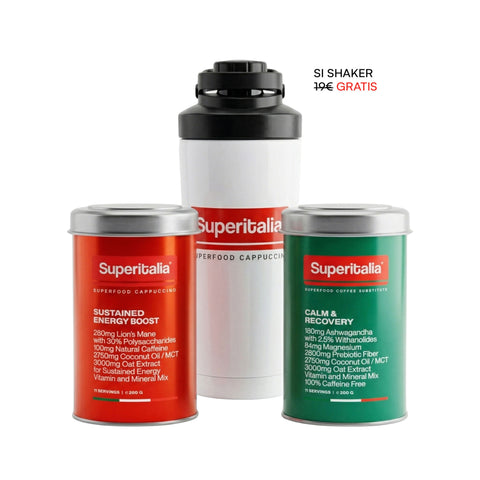
Sustained Energy Boost & Calm & Recovery – der perfekte Tagesrhythmus für alle die täglich trainieren.

The Physiology of the Coffee Crash: Why Caffeine Alone Spikes and Drops
When you drink standard black coffee, caffeine acts as an adenosine antagonist in the brain, blocking A1 and A2A receptors that normally register fatigue. Because liquid coffee triggers rapid gastric emptying, caffeine is absorbed swiftly, creating a sharp peak. Once the liver metabolizes the caffeine, the accumulated adenosine binds to its receptors all at once, resulting in a sudden, pronounced drop in energy levels.
- Rapid Gastric Emptying: Black coffee passes quickly through the stomach, leading to a sudden flood of caffeine in the bloodstream.
- Adenosine Receptor Blockade: Caffeine temporarily prevents fatigue signals from binding to receptors, masking tiredness without addressing its physical cause.
- The Backlog Effect: As caffeine is cleared, accumulated adenosine floods vacant receptors, causing a sharp rebound crash.
- Glycemic Fluctuations: Without a buffering matrix, the metabolic spike can trigger mild stress-induced glucose fluctuations that compound fatigue.
To buffer this sharp curve, specialized nutritional matrices can slow down absorption. For instance, medium-chain triglycerides, which undergo rapid oxidation and direct portal vein absorption, can provide a steady energy substrate. Similarly, soluble dietary fibers such as those in oats increase digestion viscosity, slowing gastric emptying and helping to flatten the glycemic response. Without these stabilizing elements, isolated caffeine simply provides a brief peak followed by a steep drop.
Furthermore, under European Union regulations, caffeine does not carry any authorized health claims for alertness, focus, or energy.[1] The European Parliament vetoed these claims in 2016, and under Regulation (EU) 2016/1411, claiming that caffeine improves concentration or endurance is unlawful. This is why high performers look beyond stimulant spikes toward balanced alternatives like Sustained Energy Boost to manage daily energy.
Slowing Gastric Emptying: How Soluble Oat Fiber Flattens the Curve
When you consume soluble oat fiber, it hydrates in your digestive tract to form a highly viscous gel-like solution. Research by Wood (2004) demonstrates that the physiological efficacy of beta-glucan is directly linked to this solution viscosity. This viscous barrier physically slows down gastric emptying and delays the transit of food through the small intestine. As a result, the enzymatic breakdown and subsequent absorption of carbohydrates are decelerated, preventing the sharp blood sugar spikes that lead to sudden crashes. This slow-release energy is optimal for supporting your training routine without sudden exhaustion.
- Hydrates to create a thick, viscous gel that physically delays gastric emptying.
- Slows the rate of carbohydrate digestion, leading to a gradual release of glucose.
- Flattens the insulin response by preventing sudden peaks in postprandial glucose levels.
A systematic review and meta-analysis by Zurbau (2021)[2] confirmed this mechanism, reporting a 23% reduction in the postprandial glucose incremental area under the curve (iAUC) when beta-glucan was present. However, clinical trial dosages must not be confused with functional dietary ingredients. For instance, a lipid-regulating trial by Queenan (2007)[3] used a daily dose of 6 g of concentrated oat beta-glucan. In comparison, a functional alternative might provide 3000 mg of oat extract. Because this oat extract is not equivalent to pure beta-glucan, no cholesterol-lowering claims are made. Instead, this portion helps optimize a beverage's creamy texture while supporting steady digestional transit.
Alternative Fuel: The Role of MCTs and Lion's Mane
To smooth out the stimulatory curve of caffeine, the co-ingestion of specific lipid structures plays a key physiological role. Coconut-derived medium-chain triglycerides, or MCTs, bypass the traditional lymphatic pathway and are absorbed directly via the portal vein into the liver, serving as rapid energy substrates. This efficient metabolic routing bypasses the need for bile salts, providing a steady, alternative metabolic fuel when paired with caffeine.
The other component of this blend is Lion's Mane, the mushroom Hericium erinaceus. Laboratory work has explored how elements of the mushroom might influence nerve tissue, but the active constituent has not been established. In an in-vitro study on hum[4]an astrocytoma cells by Mori et al. (2008), hericenones C, D, and E did not promote nerve growth factor gene expression, indicating that the active neurotrophic constituent of the mushroom is not yet identified. No cognitive effect is established in humans, and Lion's Mane carries no authorised EU health claim.[5]
Combining these metabolic fuels and botanicals offers a functional alternative to ordinary coffee. For example, Superitalia's Sustained Energy Boost integrates these active ingredients into a plant-based daily ritual, avoiding the chaotic spikes of a standard brew without making explicit therapeutic claims.
- 100 mg of natural Robusta caffeine to block central adenosine receptors
- 280 mg of Lion's Mane extract, standardized to 30 percent polysaccharides, to provide daily botanical support
- 3000 mg of oat extract to deliver complex, slow-digesting carbohydrates
- Coconut-derived medium-chain fats to serve as rapid energy substrates
Frequently asked questions
Why does standard coffee cause a sudden energy crash?
Standard coffee contains rapid-acting caffeine that blocks adenosine receptors, temporarily masking fatigue. Because black coffee is liquid and empties from the stomach very quickly, caffeine is absorbed rapidly, leading to a sharp spike. When the liver clears this caffeine, a flood of accumulated adenosine binds back to its receptors, causing a sudden and pronounced energy crash.
How does soluble oat fiber help flatten the energy curve?
Soluble oat fiber, particularly beta-glucan, is highly viscous. When consumed, it forms a thick gel in the digestive tract. This gel slows gastric emptying and delays carbohydrate absorption, leading to a more gradual release of glucose into the bloodstream. A meta-analysis by Zurbau in 2021 reported that oat beta-glucan can reduce the postprandial glucose incremental area under the curve by 23 percent.
What are the metabolic benefits of medium-chain triglycerides (MCTs)?
Medium-chain triglycerides, or MCTs, are specialized fats from coconut that follow unique digestion pathways. Unlike long-chain fats, they are rapidly absorbed directly via the portal vein and transported to the liver. This direct pathway bypasses the need for bile salts or extensive pancreatic lipase, allowing MCTs to be oxidized quickly and provide a rapid, stable alternative fuel source that supports stable energy.
Does Lion's Mane mushroom stimulate Nerve Growth Factor (NGF)?
While research on Hericium erinaceus extract shows it can induce Nerve Growth Factor synthesis in human astrocytoma cells, the specific active constituent is not established. A key study by Mori in 2008 demonstrated that hericenones C, D, and E did not promote NGF gene expression, meaning that despite common marketing claims, hericenones themselves are not the active stimulators.
Do functional alternatives carry official EU health claims?
No. Under EU regulations caffeine carries no authorised health claims for focus, alertness or endurance, and Lion's Mane, as a botanical, carries none either. Botanical health claims cannot be used in commercial communication, and a brand's own articles count as commercial communication. This article therefore describes both ingredients by composition and mechanism only, and makes no claim about focus, memory or cognitive performance.